Corporate Governance Structure
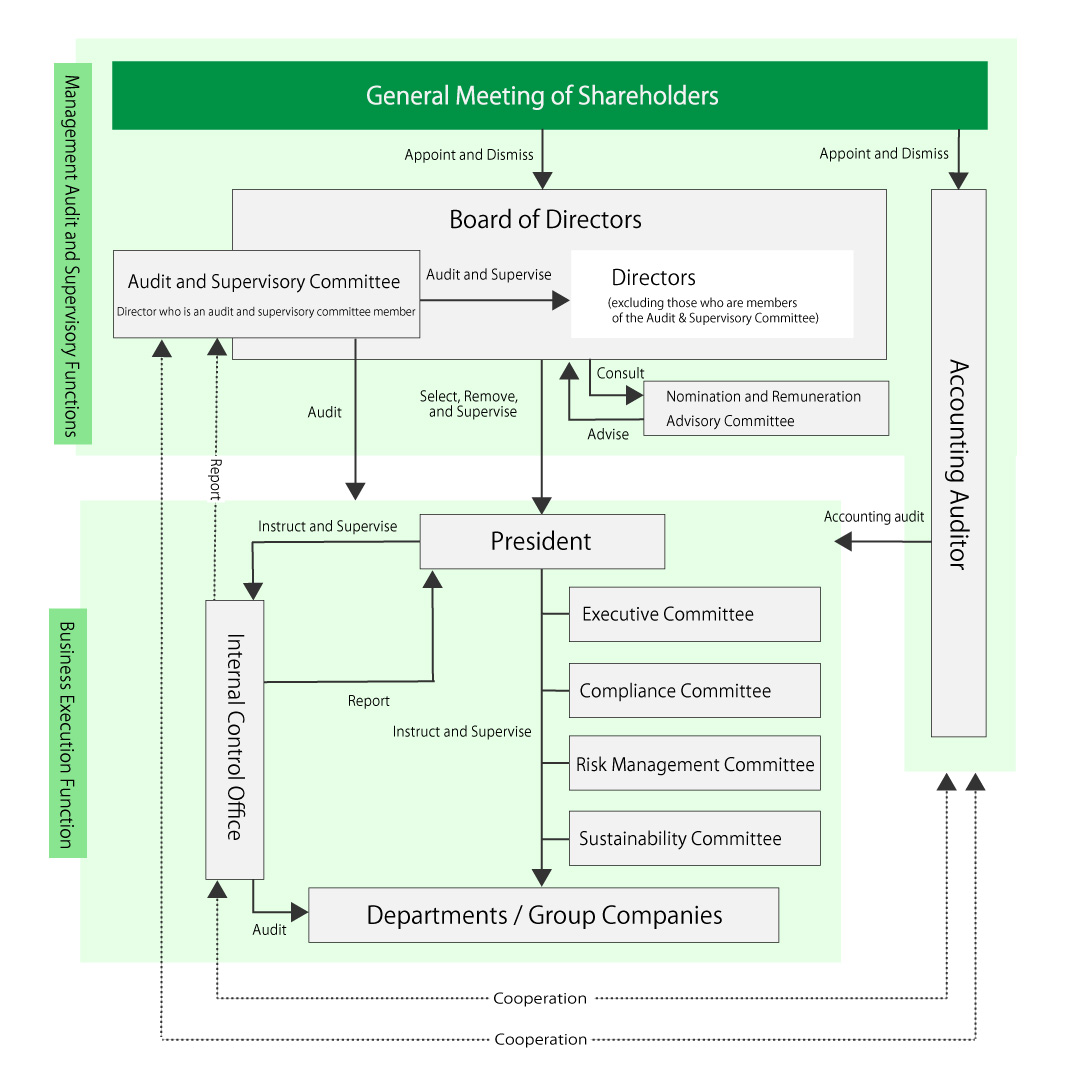
Overview of Governance
| Organizational Structure for Corporate Governance | Company with an Audit and Supervisory Committee |
| Number of Directors | 10 (including 4 outside directors) |
| Chair of the Board of Directors | President |
| Term of Office of Directors | 1 year |
| Executive Officer System | Adopted |
| Voluntary Advisory Committee to the Board of Directors |
Nomination and Compensation Advisory Committee |
| Accounting Auditor | Ernst & Young ShinNihon LLC |
Overview of Key Governance Bodies
The Board of Directors deliberates on key management matters, determines basic company policies, and manages and supervises business execution. (Regular meetings are held once a month, with extraordinary meetings convened as necessary.)
This Committee supervises management from an objective, neutral standpoint, and audits the appropriateness of the execution of duties by directors (excluding directors who are Audit and Supervisory Committee members). (Meetings are held once a month in principle.)
In response to consultations by the Board of Directors, this Committee deliberates and verifies matters relating to the nomination of director candidates (excluding directors who are Audit and Supervisory Committee members) and remuneration for these directors, the nomination of candidates for directors who are Audit and Supervisory Committee members, and succession planning, and reports the results to the Board of Directors. This arrangement ensures transparency and objectivity in decision-making.
The Executive Committee deliberates on important matters relating to business execution and helps expedite the execution of business operations. (Meetings are held once a week in principle.)
|
Title |
Name |
Board of Directors |
Audit and Supervisory Committee |
Nomination and Compensation Advisory Committee |
Executive Committee |
|
President |
Hideo Tsuji |
◎ |
〇 |
〇 |
|
|
Director, Senior Managing Executive Officer |
Koji Mori |
〇 |
〇 |
||
|
Director, Executive Officer |
Masahide Ebata |
〇 |
〇 |
||
|
Director, Executive Officer |
Atsushi Inoue |
〇 |
〇 |
||
|
Director, Executive Officer |
Koji Ono |
〇 |
〇 |
〇 |
|
|
Director (Full-Time Audit & Supervisory Committee Member) |
Yasuyuki Nagahama |
〇 |
◎ |
||
|
Outside Director (Audit & Supervisory Committee Member) |
Hidetora Yoshimine |
〇 |
〇 |
◎ |
|
|
Outside Director (Audit & Supervisory Committee Member) |
Shio Harada |
〇 |
〇 |
〇 |
|
|
Outside Director (Audit & Supervisory Committee Member) |
Chikako Irie |
〇 |
〇 |
〇 |
|
|
Outside Director (Audit & Supervisory Committee Member) |
Takuo Sukigara |
〇 |
〇 |
〇 |
“◎” indicates the chairperson. The Executive Committee chairperson rotates among committee members other than the President.
Evaluation of the Effectiveness of the Board of Directors
Every year, we analyze and evaluate the effectiveness of the Board of Directors by surveying all directors. Based on evaluations of (i) the roles and responsibilities of the Board of Directors, (ii) operation of the Board, (iii) consideration of stakeholder perspectives, and (iv) the provision of information to outside directors, we verify whether a framework is in place that enables constructive discussion and decision-making on important matters related to our Group’s management, as well as effective oversight of directors’ execution of duties.
Approach to Strategic Shareholdings
Holding policy
We believe that it is necessary to strengthen relationships and partnerships with other companies to ensure the continued stability of our business transactions. In light of this, we hold shares as strategic shareholdings only when we determine that such holdings will contribute to sustainable growth and the enhancement of corporate value over the medium to long term, after comprehensively considering factors such as our business relationship and business strategy. We will reduce our holdings of shares if we determine that there is insufficient justification for holding them.
Validation process
For each listed stock held as a strategic shareholding, the Board of Directors annually reviews whether continued ownership is appropriate by considering factors such as its medium- to long-term economic rationale and examining whether the benefits and risks of holding the stock are commensurate with the cost of capital.
Approach to exercise of voting rights
In determining how to exercise the voting rights attached to our strategic shareholdings, we individually review whether each proposal is expected to enhance the value of the investee company and whether it could damage our own corporate value. If material concerns are identified, we will vote against the proposal.
.svg)